Saturday, September 6, 2014

The Grotto

When I checked the AAA book, I saw that we were passing close to Grotto of the Redemption in West Bend, Iowa.  It sounded interesting and they have a campground in Passport America, so we took a little detour.

The Grotto was the life's work of Fr. Paul Dobberstein who gathered materials for 10 years, then, beginning in 1912, hand-built his masterpiece for 42 years.

There are nine separate grottos, each portraying a scene in the life of Christ.  This was Fr. Dobberstein's first.

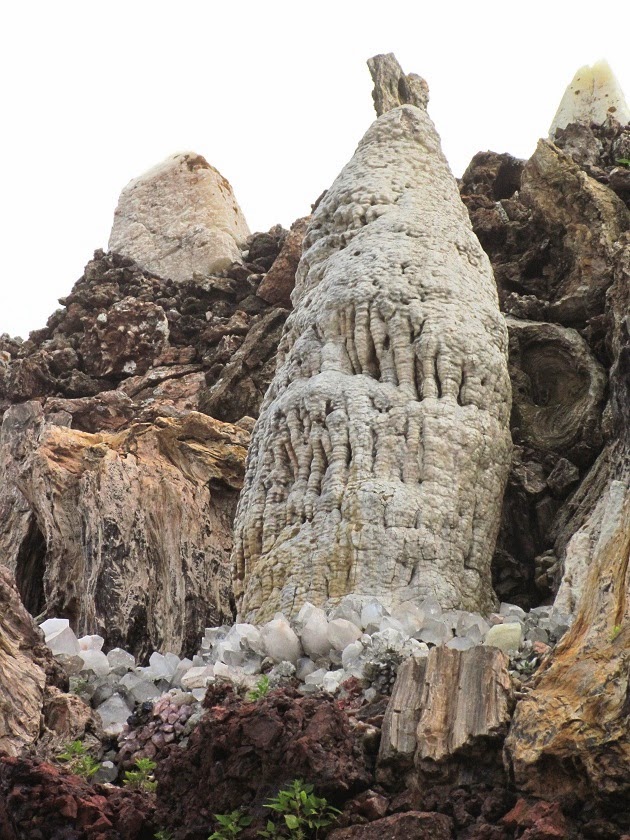
The materials used include petrified wood, malachite, jasper, quartz, agates, and more.  This stalagmite came from Carlsbad Caverns before it was a national park.
He was also ahead of his time with recycling.  When he wanted to create a stream, he decided coke bottles were the right color.  So he collected them from all the townspeople and melted them down.

He also combined melted glass and crayons to create these interesting 'rocks', surrounding some of the hundreds of agates in the Grotto.

In addition to the nine grottos, the Stations of the Cross are beautifully depicted.  The first 12 are murals, which Fr. Dobberstein ordered from Italy.

Which are displayed in these rock pavilions.

The Father did have some help with his dream.  Matt Szerensce, a parishioner, worked with Father Dobberstein and Father Louis Greving, his successor, furthered his work after his death.  At the time of his death, the Grotto was about 80% finished.
Fr. Paul Dobberstein

The complexity of the Grotto of the Redemption is mind-boggling.

The next morning I walked over from the campground to get a picture of the adjacent church.

It's certainly an impressive building for a town of 800 people.

Inside the church, Fr. Dobberstein built the Christmas Chapel in 1927.

Considered to be Father's finest work, it contains mineral specimens thought to be too delicate to be used in the outdoor grottos.  It contains an amethyst that weighs 300 pounds.

And  here's one more picture of the Grotto from the other side.

Of course pictures can't do it justice.  If you are ever anywhere near West Bend, Iowa, treat yourself to a visit to Grotto of the Redemption and be amazed.

Thursday, September 4, 2014

Returning Home

Not us, but our RV.  We brought it home to the Winnebago factory in Forest City, Iowa, for some TLC from the experts.  We were previously there seven years ago and, just like that time, we were again very impressed by the courteous and professional way they handle service visits.  We did not have an appointment (bad us), but we only had to wait two days for them to fit us in.  Then two days of work took us to the holiday weekend.  Since we never know where to go for holidays, we just stayed two more days until Labor Day.

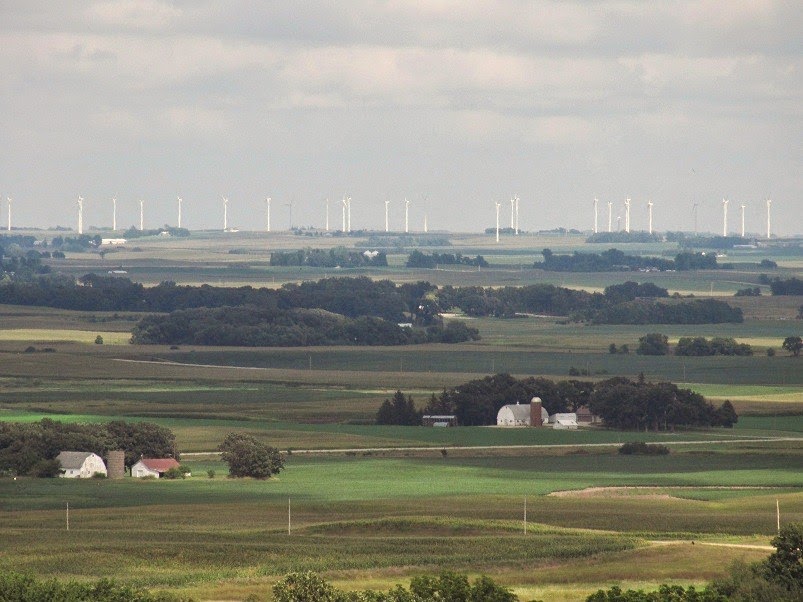
Between the massive rain storms, we did a little sightseeing.  From the top of the tower in Pilot Knob State Park, we could appreciate some of that lovely Iowa farmland.  But what is that tall white crop with the spinning blades in the distance?

And taking a stroll along the park road was this snapping turtle.  Hmm, he doesn't seem too happy with me for daring to take his picture.

We checked out Clear Lake State Park,

As well as the town of Clear Lake, where we stopped at pretty Central Gardens of North Iowa.

Nice.

For all the time we spent in Forest City, we didn't do much.  Maybe we should have revisited my favorite place from seven years ago - The Music Man Square in Mason City.  If you're a musical fan like I am, you'll love the replica of 1912 River City as seen in the 1962 film.

Our neighbors in the overnight lot, had a very interesting cover for their bikes.

And we were amazed by the RV dump in the local park - 10 dump stations!  That has to be a record.

I'm going to count this little dam on the Winnebago River as a waterfall.


Wednesday, September 3, 2014

Heading West

We decided to take a route across northern Iowa, mostly because we wanted to stop in Forest City at the Winnebago factory.  But on the way we made a couple of stops.

In Clermont we stopped at the Montauk estate.  The Italianate mansion was built in 1874 by William Larrabee who became Iowa's 12th governor in 1886.

The tour was free.  FREE!  And really very interesting.  The interior and beautiful furnishings are still as they were when the Larrabee family live there.

This was my favorite thing - a copy machine.  Something about dampening and pressing the original inked document with onion skin paper.  I could see how some of the ink would come off on the copy, but wouldn't it be backwards?

After our stop, we moved on to another wonderful Iowa city/county park in Nashua, home of the Little Brown Church in the Vale.

Built in 1860-64, the setting for the church was the inspiration for the song of the same name.  The song has been preformed by many singers, including Andy Griffith, Rosemary Clooney, and the Statler Brothers.

Funny story.  In 1857, Dr. William S. Pitts was passing through town and stopped to admire the wooded lot where the church now stands.  He went home and was inspired to write the song.  In 1862, he moved to the area.  Imagine his surprise when he saw a little brown church being built in the very spot he had envisioned it.  He dug out his song and sang it at the church dedication in 1864.


Sunday, August 31, 2014

Bottle Update

My cousin asked what brand name is on my new water bottles. So I checked and they are made by Copco.  Then I Googled the brand and discovered they are sold in Walmart, Kmart, and Target, as well as various places online, including Amazon. I guess they aren't quite the find I had thought,  but I still really like them.

Saturday, August 30, 2014

Stuff

Close to Pikes Peak State Park is the cute little town of McGregor, Iowa.  Coming into town, my first thought was, "Shouldn't that be MacGregor?"  Well the founder was named MacGregor, but I guess the 'a' was dropped somewhere along the way.

Although I don't write a post about every town we see, McGregor had some quaint sights.

Sadie's Log Cabin was built in 1848 and moved to town.  It's now a part of Little Switzerland Inn and you can stay in it.

I googled it and the inside looks nothing like you would expect.  To see it, click here.

We were amazed when we spotted this 'House IN the Rock'.

For a town with a population of less than 1000, it seems to be doing pretty well.  Even the building that was boarded up was done so artistically.

This statue is by the riverboat casino.  Is it some kind of a warning?

I just have to show off my big find.  When it comes to drinking water on a hike, I prefer to use a regular water bottle.  I've been refilling used ones and know it's supposed to be unhealthy.  Since I'm cheap and have environmental objections to buying cases of bottled water, I've tried a couple of options with unhappy results.  I don't like the taste of the metal bottles and using the wide-mouthed BPA free bottle results in me dribbling the water down my shirt.

Then I happened upon these BPA free bottles in ShopKo.

Nice hard plastic with an added feature for easy filling and ice.

I'm a happy camper!

Thursday, August 28, 2014

Back into Iowa

Crossing into northern Iowa, we stayed a few days at Pikes Peak State Park.  Iowa Parks have no day use fee and the camping fees are a bit cheaper than Wisconsin.  Our electric site was $16 a night, well worth it since it was hot and unbelievably humid.

The park is situated on a 500 foot bluff overlooking the Mississippi.  I didn't take any pictures.  (What???)  Well, except for this coleus that I thought was unique.

One hot day we decided to drive to nearby Effigy Mounds National Monument.   In 1948, President Truman established the monument to protect the 200+ mounds located within its borders.

The effigy mounds, for which the park was named,  were built from 700 to 1300 and are most commonly in the shape of bears and birds. Although we saw a couple of bear mounds, they are impossible to photograph.  Luckily, at one time, the park service outlined them with lime and took aerial pictures.  I snapped this during the movie at the visitor center.

There are also many circular mounds which were created as long as 3000 years ago.  Archaeologists have determined that they are burial mounds.


Perched high atop the bluffs, it seems like a nice place to honor the dead.

The views of the Mississippi were lovely, but you could just see all the humidity in the air.

Along the trail, this artistic-looking toadstool (?) grabbed our attention.


Tuesday, August 26, 2014

Wisconsin Wrap-up

After reading my last three marathon posts on the House on the Rock, you'll be happy to know I just have one short one to finish our trip west across southern Wisconsin.  Near HOTR is Tower Hill State Park, home of a shot tower that was in use from 1833 to 1861.  It was used to form molten lead into shot (buckshot size and smaller.)

I found the whole process fascinating.

Wow!  Who came up with that idea?  Actually, the answer was provided.

The method used was the “Watts Method” named after an English plumber who, watching raindrops fall, envisioned droplets of melted lead falling in the same manner and becoming round as they fell.

 We hiked first to the base of the 60 foot tower,

Where we could look down the beginning of the 120 foot shaft hand-dug through the cliff.

After we climbed to the smelter house at the top, we could see the path of the falling lead, though the 60 foot tower and into the 120 foot shaft.

Here's a diagram of how the system worked.

Although the smelter house and tower were certainly reproductions, the shaft is quite a story.  In 1831, Thomas Bolton Shaunce was hired to dig the 120 foot shaft, plus a 90 foot tunnel connecting it to the riverbank. He worked mostly alone, but had some help from a fellow miner, Malcom Smith.  They dug the shaft and tunnel with typical miners tools, pick and gad (a straight pointed bar), and hauled the rock out with buckets. The work stopped temporarily in 1832 during the Blackhawk War when both men enlisted to fight.  After the war, Shaunce returned to finish the job.  He worked a total of 187 days and was never paid the $1000 he had been promised, but did receive some land instead.  What a feat!

Almost just as amazing were the following statistics:

When in full operation, a crew of six operated the shot tower, dropping up to 5,000 pounds of lead per day. Of this, only about 600 to 800 pounds was usable shot. The rest was hauled back to the top of the tower, melted and dropped again.

Truly back breaking work, even with ox carts to haul the lead back to the top.  This might go at the top of jobs I would never do.